Part-time work: what is left net? (Excel)
Compare your gross salary and an indicative net salary at 100, 90, 80, 60 and 50% and see the difference per month and per year, including the effect on holiday pay and the end-of-year bonus.
You see at a glance that one day less per week costs you less than 20% of your net pay, and exactly how much under your own assumptions.
- Last updated:
- Published:
Available versions
FreeChoose the version that suits you. All versions are free.
Basic
Version 1.0 · last updated September 24, 2026Gross and indicative net at 100, 90, 80, 60 and 50%, difference per month and per year, effect on holiday pay and end-of-year bonus, and costs that disappear.
Works with Excel 2016+, Microsoft 365, LibreOffice Calc
Download Basic (English, 9 kB)Also available in: Nederlands, Français
Free · No account · No email
Prefer not to download? This tool also exists as an online calculator.
Open the online calculatorIn short
Part-time work means your working hours are lower than those of a full-time employee in your company; your gross salary falls proportionally, but your net salary falls less because personal income tax is progressive.
One day less per week costs you 20% of your gross salary, but not 20% of your net. Because tax rises per bracket, the last part of your salary sits in the highest bracket and that is the part you keep the least of. This Excel puts your gross salary, the social security contribution, an indicative withholding tax and the net salary side by side for five working regimes, and shows the difference per month and per year.
What does this tool do?
On the “Input” sheet you enter your full-time gross salary. The file calculates the gross at 90, 80, 60 and 50%, deducts the employee social security contribution of 13.07% and then applies withholding tax using a simplified rate model you can adjust yourself. That gives you an indicative net salary per regime, not a payslip.
You then see the difference with your current situation: per month, per year and as a percentage. The file also shows how double holiday pay and the end-of-year bonus fall along with the salary, since they are proportional to it, and lets you enter costs that disappear when you work less, such as a day of childcare, commuting costs or meals out.
The result is an honest starting point for a conversation with your employer or your partner. If you are considering time credit (tijdskrediet) or parental leave, an interruption allowance from the RVA/ONEM can cover part of the difference; the file deliberately does not calculate that allowance, but there is a line where you can enter the amount yourself.
Who is it for?
- Employees considering going 4/5 or half-time who want to know what that means net.
- Young parents weighing the cost of childcare against one day less at work.
- Anyone considering time credit, parental leave or an end-of-career job who wants to see the salary difference first.
- Couples working out which of them should reduce their hours, with the smallest loss of household income.
What is included?
- Input sheet with your full-time gross salary, the desired working regime and adjustable percentages for social security and withholding tax.
- Table with gross salary, social security contribution, taxable salary, withholding tax and indicative net at 100, 90, 80, 60 and 50%.
- Difference compared with full-time per month, per year and in percent.
- Line for double holiday pay and the end-of-year bonus in proportion to the working regime.
- Lines for costs that disappear (childcare, commuting, meals) and for an optional interruption allowance you enter yourself.
- A note on every assumption, so you know which figure to check on your payslip.
How do you use the file?
- 1
Open the file and go to the “Input” sheet. Only the yellow cells are meant to be filled in.
- 2
Enter your current gross monthly salary as it appears at the top of your payslip, without holiday pay or the end-of-year bonus.
- 3
Check the employee social security contribution. The default is 13.07%; leave it unless you work under a special status.
- 4
Adjust the withholding tax: take the amount from your current payslip and divide it by your taxable salary to know your real percentage. For the part-time regimes you can set a lower percentage, because a lower salary falls into lower tax brackets.
- 5
Enter the costs that disappear when you work less, for example one day of childcare per week or fewer commuting kilometres. Optionally enter the interruption allowance you would receive from the RVA/ONEM.
- 6
Look at the “Overview” sheet: it shows the indicative net salary per regime, the difference per month and per year and the effect on holiday pay and the end-of-year bonus. Change the regime to compare scenarios.
Worked example
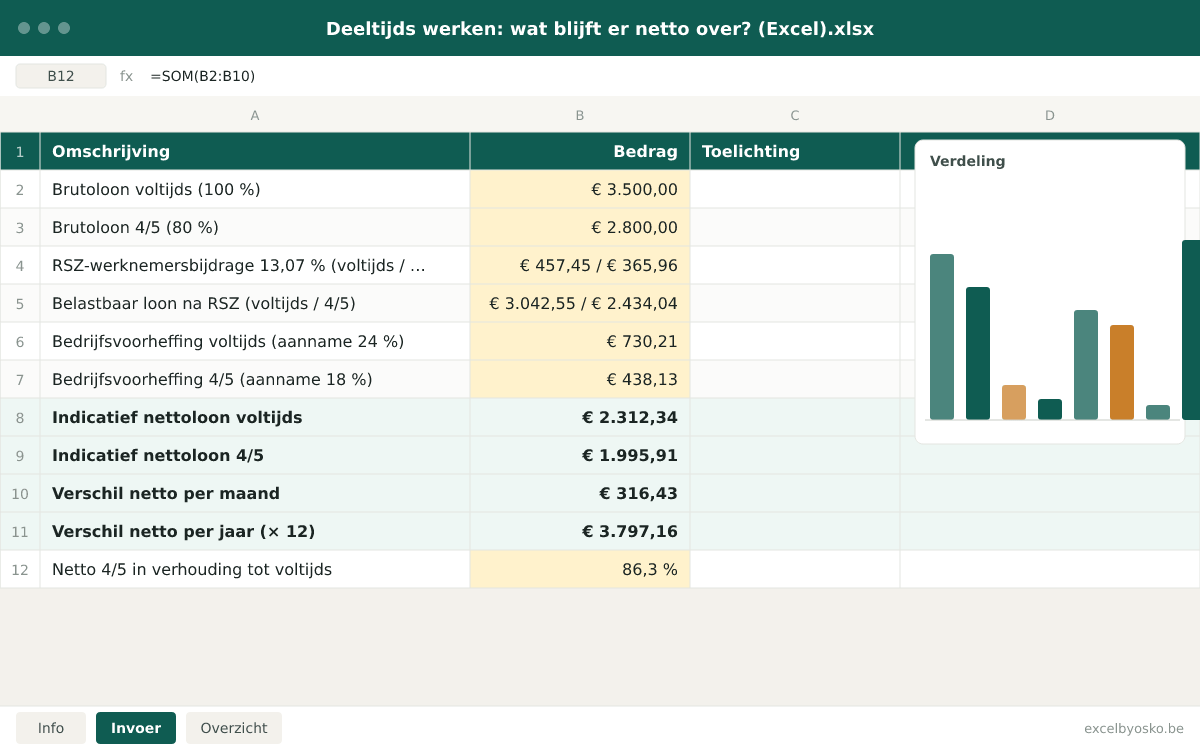
A white-collar employee with a full-time gross salary of €3,500 goes 4/5. The social security contribution is 13.07%; the withholding tax is an assumption of 24% of taxable salary at full-time and 18% at 4/5, to illustrate progressivity. These are indicative figures, not a payroll calculation.
| Gross salary full-time (100%) | €3,500.00 |
|---|---|
| Gross salary 4/5 (80%) | €2,800.00 |
| Employee social security 13.07% (full-time / 4/5) | €457.45 / €365.96 |
| Taxable salary after social security (full-time / 4/5) | €3,042.55 / €2,434.04 |
| Withholding tax full-time (assumed 24%) | €730.21 |
| Withholding tax 4/5 (assumed 18%) | €438.13 |
| Indicative net salary full-time | €2,312.34 |
| Indicative net salary 4/5 | €1,995.91 |
| Net difference per month | €316.43 |
| Net difference per year (× 12) | €3,797.16 |
| Net at 4/5 as a share of full-time | 86.3% |
Gross falls by 20%, the indicative net by 13.7%. If €120 per month of childcare and commuting costs also disappear, the real difference becomes €196.43 per month. Double holiday pay and the end-of-year bonus do fall in proportion to salary, so by 20%.
Sources & calculation method
This is how the calculation is built:
- Gross salary per regime = full-time gross × percentage (100, 90, 80, 60 or 50%). That is proportional; a 4/5 regime gives 80% of the full-time gross.
- Employee social security contribution = gross salary × 13.07%. Taxable salary is gross minus that contribution. Reductions such as the work bonus for low salaries are not in the model.
- Withholding tax = taxable salary × the percentage you set per regime. The model deliberately uses an effective percentage instead of the official scales; those depend on your family situation and change every year.
- Indicative net salary = taxable salary − withholding tax. Difference per month = net full-time − net part-time; per year = difference × 12. Disappearing costs and an optional interruption allowance are deducted from that difference.
- Double holiday pay and the end-of-year bonus are calculated proportionally: full-time amount × working regime. The file does not convert them to net.
Assumptions
- The employee social security contribution of 13.07% applies to private-sector employees: 7.50% pensions, 3.55% healthcare, 1.15% sickness and disability benefits and 0.87% unemployment, according to the administrative instructions of the RSZ/ONSS.
- Withholding tax is an assumption you enter yourself. The real amount depends on your family situation, dependent children and the scales of the year; the final tax follows through your personal income tax return.
- Holiday pay and the end-of-year bonus are calculated proportionally. Some sectors apply other rules, for example blue-collar workers who receive their holiday pay through the RJV/ONVA.
- The model assumes a single gross salary, without meal vouchers, benefits in kind or bonuses. You can include those separately in the household budget.
Limitations
- The file is not a payroll calculation and does not replace a simulation by your employer or payroll provider.
- It does not calculate the RVA/ONEM interruption allowance for time credit or thematic leave; you enter that amount yourself.
- The effect on your pension build-up is not quantified; some forms of time credit are assimilated, plain part-time work is not.
Sources
- Sociale Zekerheid – Administratieve instructies RSZ: de socialezekerheidsbijdragen
Used for: Table of contribution percentages per social security branch; the employee share in the private sector (7.50 + 3.55 + 1.15 + 0.87) adds up to 13.07%.
Accessed: September 24, 2026
- FOD Financiën – Belastingtarieven personenbelasting
Used for: The progressive system with tax brackets from 25% to 50%, the reason net pay falls less than gross pay.
Accessed: September 24, 2026
- FOD Werkgelegenheid, Arbeid en Sociaal Overleg – Deeltijdse arbeid
Used for: What part-time work means legally and which rules apply to the contract and schedules of part-time employees.
Accessed: September 24, 2026
- RVA – Tijdskrediet (privésector)
Used for: The right to time credit with the employer and to interruption allowances from the RVA/ONEM, as an alternative to a plain contract reduction.
Accessed: September 24, 2026
This page and the file were last updated on September 24, 2026. Legislation and rates may have changed since.
Frequently asked questions
How much net do I lose if I go 4/5?
Less than 20%. Your gross salary falls by a fifth, but your net falls less because personal income tax is progressive: the highest slice of your salary is taxed most heavily and that is exactly the slice that disappears. In the example above, gross falls by €700 per month but the indicative net by €316.43, or 13.7%. The exact figure depends on your salary, your family situation and the withholding tax scales; ask your employer for a simulation.
What is the employee social security contribution in Belgium?
Private-sector employees pay 13.07% of their gross salary to social security. That percentage is the sum of four branches: 7.50% for pensions, 3.55% for healthcare, 1.15% for sickness and disability benefits and 0.87% for unemployment. The employer withholds it and passes it on to the RSZ/ONSS. For low salaries there is a reduction, the work bonus, which the file does not include. The percentages are published in the administrative instructions of the RSZ/ONSS.
Does my holiday pay drop if I work part-time?
Yes. Double holiday pay for white-collar employees is calculated on the salary of the holiday reference year, meaning the year before the holiday. If you work 4/5 for a whole year, the year after you receive about 80% of the double holiday pay you would have received full-time. The number of holiday days also falls proportionally. The same applies to the end-of-year bonus in most sectors. In the year of the switch itself you often still see a mixed amount.
What is the difference between part-time work and time credit?
With plain part-time work you change your employment contract, usually permanently, and receive only your lower salary. Time credit (tijdskrediet or crédit-temps) is a temporary reduction or interruption while keeping your full-time contract, subject to seniority conditions and with a motive such as caring for a child or following training. If you meet the conditions, you then receive an interruption allowance from the RVA/ONEM on top of your part-time salary. Parental leave and other thematic leaves work in a similar way. The conditions are on the RVA/ONEM website.
Does part-time work affect my pension?
Yes. The employee pension is calculated on the length of your career and your salaries; a lower salary therefore means a lower pension for those years. Periods of time credit with a motive and thematic leave are assimilated under certain conditions, so they count as if you had worked. Plain part-time work without an allowance is not assimilated. Check your personal situation on mypension.be and ask the Federal Pensions Service.
Osko Consult
Want more insight into your financial situation?
Osko Consult builds overviews, calculators and dashboards to order, also for small organisations and self-employed people. An Excel that does exactly what you need, instead of a template that almost fits.
Related tools
- Excel template
Belgian personal income tax calculator in Excel
Estimate the Belgian personal income tax on your salary or profit: tax brackets, personal tax allowance and municipal tax for assessment year 2026, with the assessment year 2027 figures already in the parameter sheet.
Individuals · Self-employedFree - Excel template
Household budget template in Excel
Line up your income, fixed costs and variable spending month by month and see straight away how much is left to save, with a comparison between budget and actual.
IndividualsFree - Excel templateOnline calculator
Car cost calculator in Excel
Work out what your car really costs per year, per month and per kilometre: depreciation, insurance, road tax, fuel or charging, maintenance and more.
Individuals · Self-employedFree - Excel templateOnline calculator
Loan repayment calculator in Excel
Work out your monthly payment, see in a full repayment schedule how much interest and capital you pay each month, and find out what a loan costs you over its whole term.
Individuals · Self-employedFree