Belgian personal income tax calculator in Excel
Estimate the Belgian personal income tax on your salary or profit: tax brackets, personal tax allowance and municipal tax for assessment year 2026, with the assessment year 2027 figures already in the parameter sheet.
In five minutes you know roughly how much income tax you owe and which part of your income falls in which bracket.
- Last updated:
- Published:
Available versions
FreeChoose the version that suits you. All versions are free.
Short version
Version 1.0 · last updated September 24, 2026Basic calculation for one person: tax brackets, personal tax allowance and municipal tax, with the parameters of the stated assessment year in a separate parameter sheet.
Works with Excel 2016+, Microsoft 365, LibreOffice Calc
Download Short version (English, 9 kB)Also available in: Nederlands, Français
Extended version
Version 1.0 · last updated September 24, 2026With family situation, dependent children (higher personal tax allowance), actual or flat-rate professional expenses and a comparison of two scenarios.
Works with Excel 2016+, Microsoft 365, LibreOffice Calc
Download Extended version (English, 9 kB)Also available in: Nederlands, Français
Free · No account · No email
In short
Personal income tax is the federal tax on the yearly income of Belgian residents, calculated with progressive brackets of 25 to 50 %, reduced by a personal tax allowance and increased by an additional municipal tax.
How much of a pay rise do you keep? What does extra income do to your final tax bill? Belgian personal income tax works with brackets, so the answer is not a single percentage. This Excel works out step by step what you owe, indicatively, with the official rates and amounts of the assessment year you choose.
What does this tool do?
You enter your gross annual income as an employee, or your net taxable income as a self-employed person. The file deducts the employee social security contribution and the flat-rate professional expenses, spreads the taxable income over the brackets of 25, 40, 45 and 50 %, applies the personal tax allowance and finally adds the municipal tax at the rate of your municipality.
All rates and amounts sit in a separate parameter sheet, with the figures for assessment year 2026 (income 2025) and assessment year 2027 (income 2026) as published by the Belgian tax administration, FPS Finance: bracket limits of 16,320, 28,800 and 49,840 euros for assessment year 2026, a personal tax allowance of 10,910 euros and flat-rate expenses capped at 5,930 euros. You pick the assessment year from a dropdown.
The extended version adds the family situation: dependent children increase the personal tax allowance, you can enter actual professional expenses instead of the flat rate, and you compare two scenarios side by side, for example your current salary against an offer from a new employer, or flat-rate against actual expenses.
Who is it for?
- Employees who want to know how much tax falls on their salary and why the final bill differs from the withholding tax on their payslip.
- Anyone considering a pay rise, a new job or extra income who wants to see what is left after tax.
- Self-employed people with a sole proprietorship who want an indication of the income tax on their profit before talking to their accountant.
- Students and newcomers who want to understand how tax brackets, the personal tax allowance and municipal tax work together.
What is included?
- Input sheet with gross annual salary or taxable income, the choice of assessment year and the municipal tax rate of your municipality.
- Parameter sheet with the tax brackets, the personal tax allowance and the cap on flat-rate professional expenses for assessment years 2026 and 2027, with sources.
- Calculation per bracket: how much income falls in each bracket and how much tax each bracket produces.
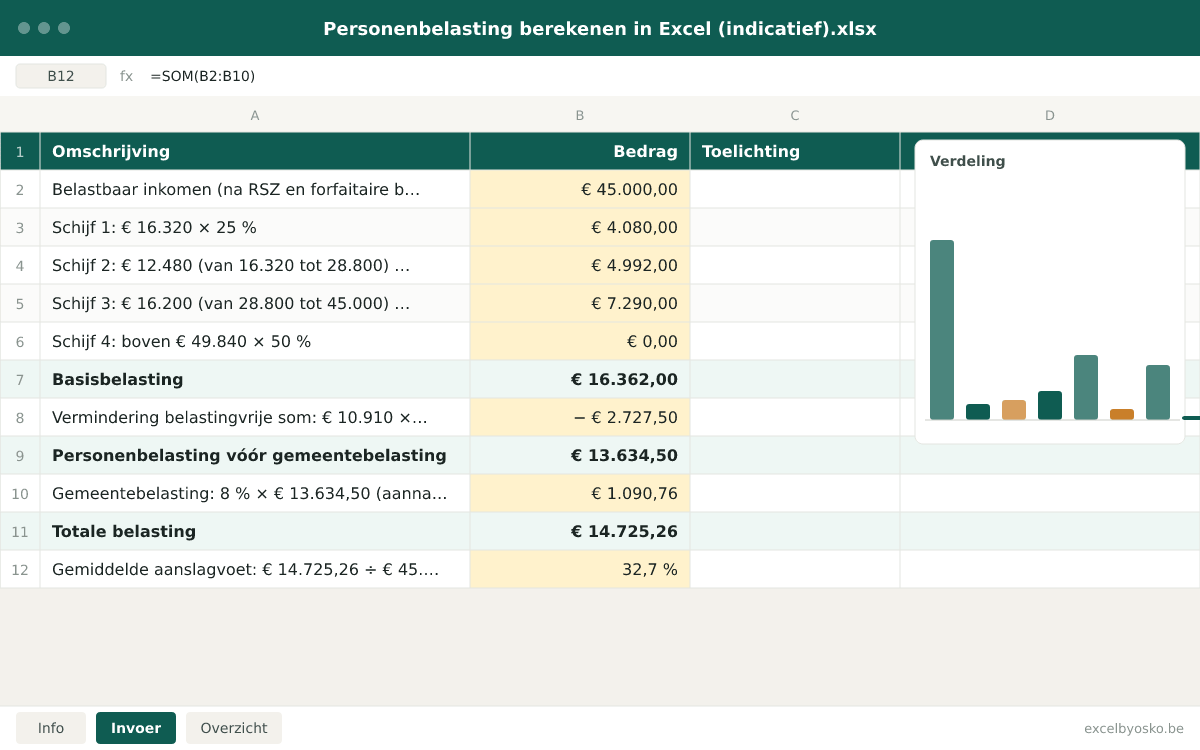
- Overview sheet with basic tax, the reduction for the personal tax allowance, municipal tax, total tax and the average and marginal tax rate.
- Chart showing which part of your income falls in which bracket.
- Family situation, dependent children, actual professional expenses and a comparison of two scenarios (extended version).
How do you use the file?
- 1
Open the file and go to the “Input” sheet. Only the yellow cells are meant to be filled in; every other cell contains a formula.
- 2
Choose the assessment year from the dropdown: assessment year 2026 for income earned in 2025, assessment year 2027 for income earned in 2026. The file pulls the matching brackets and amounts from the parameter sheet.
- 3
Enter your gross annual salary (the total of your payslips, before social security contributions and withholding tax). If you are self-employed, enter your net taxable income and set the social security line to zero.
- 4
Keep the flat-rate professional expenses, or choose actual expenses in the extended version and enter the amount you can prove.
- 5
Enter the municipal tax rate of your municipality. You find it in the list published by FPS Finance or at the bottom of your last tax assessment notice.
- 6
Look at the “Overview” sheet: it shows the tax per bracket, the reduction for the personal tax allowance, the municipal tax and the total. Compare it with the withholding tax on your payslips to estimate whether you will pay extra or get a refund.
Worked example
A single employee without dependent children, assessment year 2026 (income 2025), with a taxable income of €45,000. That is what remains after the social security contribution and the flat-rate professional expenses (maximum €5,930) have been deducted from gross salary. The municipal tax of 8 % is an assumption.
| Taxable income (after social security and flat-rate expenses) | €45,000.00 |
|---|---|
| Bracket 1: €16,320 × 25 % | €4,080.00 |
| Bracket 2: €12,480 (from 16,320 to 28,800) × 40 % | €4,992.00 |
| Bracket 3: €16,200 (from 28,800 to 45,000) × 45 % | €7,290.00 |
| Bracket 4: above €49,840 × 50 % | €0.00 |
| Basic tax | €16,362.00 |
| Reduction for the personal tax allowance: €10,910 × 25 % | − €2,727.50 |
| Personal income tax before municipal tax | €13,634.50 |
| Municipal tax: 8 % × €13,634.50 (assumption) | €1,090.76 |
| Total tax | €14,725.26 |
| Average tax rate: €14,725.26 ÷ €45,000 | 32.7 % |
Every extra euro above €45,000 falls in the 45 % bracket and, with 8 % municipal tax, costs 48.6 cents in tax. That is the marginal rate, well above the average rate of 32.7 %. On the tax assessment notice, the withholding tax already deducted from your salary is then subtracted.
Sources & calculation method
This is how the calculation is built:
- From gross to taxable: the employee social security contribution comes off gross salary first (13.07 % for employees: 7.50 % pension, 3.55 % and 1.15 % health and disability insurance and 0.87 % unemployment, according to the administrative instructions of the NSSO). The file then deducts the flat-rate professional expenses: 30 % with a maximum of 5,930 euros for assessment year 2026 and 6,070 euros for assessment year 2027. What remains is the taxable income.
- Brackets: the taxable income is spread over the brackets of the chosen assessment year. For assessment year 2026: 25 % up to 16,320 euros, 40 % from 16,320 to 28,800 euros, 45 % from 28,800 to 49,840 euros and 50 % above that. For assessment year 2027 the limits are 16,720, 29,510 and 51,070 euros. The sum of the tax per bracket is the basic tax.
- Personal tax allowance: it is not deducted from income but converted into a reduction. The tax that would be due on the amount of the allowance (10,910 euros × 25 % = 2,727.50 euros for assessment year 2026; 11,180 euros for assessment year 2027) is subtracted from the basic tax. In the extended version, dependent children increase the allowance by the amounts in the parameter sheet.
- Reductions: in reality, tax reductions follow next, such as for pension savings, donations or service vouchers. The file deliberately does not calculate them; the result is an indication of the tax before reductions.
- Municipal tax: your municipality levies a percentage of the personal income tax. The file applies the rate you enter. According to the FPS Finance list for assessment year 2026, that rate ranges from 0 to 9 %; 8 % is the most common and roughly three in four municipalities sit between 7 and 8.5 %. The total, minus the withholding tax already deducted, is what you pay extra or get back.
Assumptions
- The file uses the rates and amounts published by FPS Finance for assessment year 2026 (income 2025) and assessment year 2027 (income 2026). Check the parameter sheet after a new indexation.
- The 13.07 % social security contribution applies to private-sector employees. Self-employed people enter their net taxable income, after social contributions and professional expenses, as their accountant calculates it.
- Municipal tax is the rate you enter; the example uses 8 %. Check the exact rate of your municipality in the official list.
- All income is treated as jointly taxable professional income. Income taxed separately, such as certain allowances or income from the sharing economy, is not covered.
Limitations
- The short version calculates for one person: no marital quotient, no dependent children and no joint return. The extended version adds dependent children and the family situation, but remains a simplification.
- Tax reductions such as pension savings, donations, service vouchers or the housing bonus are not included; the result is an estimate, not a tax assessment notice.
- The file does not replace Tax-Calc or MyMinfin: for a complete provisional calculation with all your codes, use the applications of FPS Finance.
Sources
- FOD Financiën – Belastingtarieven (belastingschijven en belastingvrije som)
Used for: Tax brackets, rates and personal tax allowance for assessment years 2026 and 2027, and the worked example of FPS Finance.
Accessed: September 24, 2026
- FOD Financiën – Beroepsinkomen (forfaitaire beroepskosten)
Used for: Percentage and cap of the flat-rate professional expenses for employees and company directors, assessment years 2026 and 2027.
Accessed: September 24, 2026
- FOD Financiën – Gemeentebelasting (aanslagvoeten per gemeente)
Used for: How the additional municipal tax works, and the official list of rates per municipality for assessment year 2026 (0 to 9 %).
Accessed: September 24, 2026
- FOD Financiën – Belastingaangifte 2026 (termijnen)
Used for: Filing deadlines for the 2026 tax return and the role of withholding tax as an advance on the final tax.
Accessed: September 24, 2026
- Sociale Zekerheid – Administratieve instructies RSZ: de bijdragen
Used for: Employee share of the social security contributions per branch (13.07 % in total).
Accessed: September 24, 2026
This page and the file were last updated on September 24, 2026. Legislation and rates may have changed since.
Frequently asked questions
How much tax do I pay on €45,000 of taxable income?
For assessment year 2026 (income 2025), a single person without dependent children pays €16,362 of basic tax on €45,000 of taxable income: 25 % on the first €16,320, 40 % on the bracket up to €28,800 and 45 % on the rest. The reduction for the personal tax allowance (€2,727.50) comes off, leaving €13,634.50. With 8 % municipal tax the total comes to €14,725.26, or 32.7 % of taxable income. Tax reductions such as pension savings can lower that amount further.
What is the personal tax allowance (belastingvrije som)?
The personal tax allowance is the part of your income on which you pay no tax. The basic amount is 10,910 euros for assessment year 2026 (income 2025) and 11,180 euros for assessment year 2027 (income 2026). In practice it is not deducted from your income but converted into a reduction: the tax that would be due on that amount is subtracted from your basic tax. With children or other dependants the allowance is increased, and anyone earning less than the allowance pays no tax at all.
Why is my withholding tax different from my final tax?
The withholding tax (bedrijfsvoorheffing) your employer deducts every month is an advance on the final tax. It is calculated on your monthly salary according to fixed rules that ignore your total income, your actual professional expenses, reductions such as pension savings and the exact municipal tax rate. In the final assessment, FPS Finance calculates the tax on your full annual income and subtracts the withholding tax already paid. The difference appears on your tax assessment notice: a refund or an amount to pay.
When do I have to file my tax return?
For the 2026 tax return (income 2025), FPS Finance sets three deadlines: 30 June 2026 if you send the paper return by post, 19 July 2026 if you file your return or modify your proposal for a simplified return via MyMinfin (Tax-on-web), and 16 October 2026 if you declare specific income online, such as self-employed income or foreign professional income. Filing late can lead to a fine or a tax increase. If you received a proposal for a simplified return, check it and only change it if something is missing or wrong.
Which tax brackets apply to income earned in 2026 (assessment year 2027)?
FPS Finance has already published the indexed amounts for assessment year 2027. The 25 % bracket runs up to 16,720 euros, the 40 % bracket up to 29,510 euros and the 45 % bracket up to 51,070 euros; above that the rate is 50 %. The personal tax allowance rises to 11,180 euros and the cap on flat-rate professional expenses for employees to 6,070 euros. Select assessment year 2027 in the file to calculate with those figures, for example to check the withholding tax of 2026 against the final tax you can expect.
Osko Consult
Want this calculation tailored to your situation or your clients?
Osko Consult builds custom calculators and Excel models, with your parameters, your house style and the checks that matter to you.
Related tools
- Excel templateOnline calculator
Part-time work: what is left net? (Excel)
Compare your gross salary and an indicative net salary at 100, 90, 80, 60 and 50% and see the difference per month and per year, including the effect on holiday pay and the end-of-year bonus.
IndividualsFree - Excel template
Salary vs dividend comparison in Excel
Compare what is left net when your company pays out the same profit as director’s salary or as a dividend, with corporate tax, social contributions, personal income tax and withholding tax.
Self-employedFree - Excel template
Household budget template in Excel
Line up your income, fixed costs and variable spending month by month and see straight away how much is left to save, with a comparison between budget and actual.
IndividualsFree - Excel template
Sole trader or company? Compare in Excel
Compare, for the same profit, what you keep net as a sole trader and as a company, including the extra yearly costs of a company, and see from which profit level a bv starts to pay off.
Self-employedFree