Car cost calculator in Excel
Work out what your car really costs per year, per month and per kilometre: depreciation, insurance, road tax, fuel or charging, maintenance and more.
In ten minutes you know what your car actually costs you, and you can compare two cars fairly.
- Last updated:
- Published:
Available versions
FreeChoose the version that suits you. All versions are free.
Basic
Version 1.0 · last updated September 24, 2026One car: all costs per year, per month and per kilometre, with a chart of the breakdown.
Works with Excel 2016+, Microsoft 365, LibreOffice Calc
Download Basic (English, 9 kB)Also available in: Nederlands, Français
Extended
Version 1.0 · last updated September 24, 2026Two cars side by side, with financing costs and a petrol, diesel or electric comparison.
Works with Excel 2016+, Microsoft 365, LibreOffice Calc
Download Extended (English, 9 kB)Also available in: Nederlands, Français
Free · No account · No email
Prefer not to download? This tool also exists as an online calculator.
Open the online calculatorIn short
The total cost of ownership of a car is the sum of every cost it causes over its period of use: depreciation, fixed costs such as insurance and road tax, and variable costs such as fuel, maintenance and tyres.
The purchase price says little about what a car costs you. Depreciation, insurance, road tax, fuel or charging, maintenance and tyres all come on top. This Excel adds everything up and shows the cost per year, per month and per kilometre driven.
What does this tool do?
You enter the costs of your car on a single input sheet: what you paid, what you expect it to be worth when you sell it, how many kilometres you drive per year and what the fixed and variable costs are. The file calculates the yearly depreciation, adds up all costs and divides them by twelve months and by the number of kilometres.
The result is an honest picture of your car costs. For many households the car turns out to be the second largest expense after housing. Knowing that figure helps you decide about a new car, a second car, an electric model or an alternative such as car sharing or public transport.
The extended version puts two cars side by side, with the financing costs of a car loan and a comparison between petrol, diesel and electric driving based on your own consumption and prices.
Who is it for?
- Individuals who want to buy a car and see the full picture before deciding.
- Households weighing a second car against a public transport subscription or a shared car.
- Self-employed people who want an indication of the cost of their car before discussing deductibility with their accountant.
- Anyone considering an electric car who wants to compare the costs with a petrol or diesel car.
What is included?
- Input sheet with every cost item, clearly separated into one-off, fixed and variable costs.
- Automatic depreciation calculation based on purchase price, expected residual value and period of use.
- Cost per year, per month and per kilometre, based on your expected annual mileage.
- Chart with the breakdown of costs per category, so you see where the money goes.
- Comparison sheet for two cars and a line for financing costs (extended version).
- A note next to every input cell, so you know which amount to enter and where to find it.
How do you use the file?
- 1
Open the file and go to the “Input” sheet. Only the yellow cells are meant to be filled in.
- 2
Enter the purchase price, the expected residual value and the number of years you expect to keep the car. For a realistic residual value, look up similar cars of that age on second-hand sites.
- 3
Enter your annual mileage. Check your last inspection certificate or maintenance invoice for the odometer reading and work backwards.
- 4
Enter the fixed costs: insurance, road tax, breakdown assistance, inspection and possibly a fixed parking space. You find these amounts on your yearly invoices.
- 5
Enter the variable costs: consumption per 100 km, price per litre or kWh, and a yearly amount for maintenance and tyres.
- 6
Look at the “Overview” sheet: it shows the cost per year, per month and per kilometre, with a chart. Change figures on the input sheet to compare scenarios.
Worked example
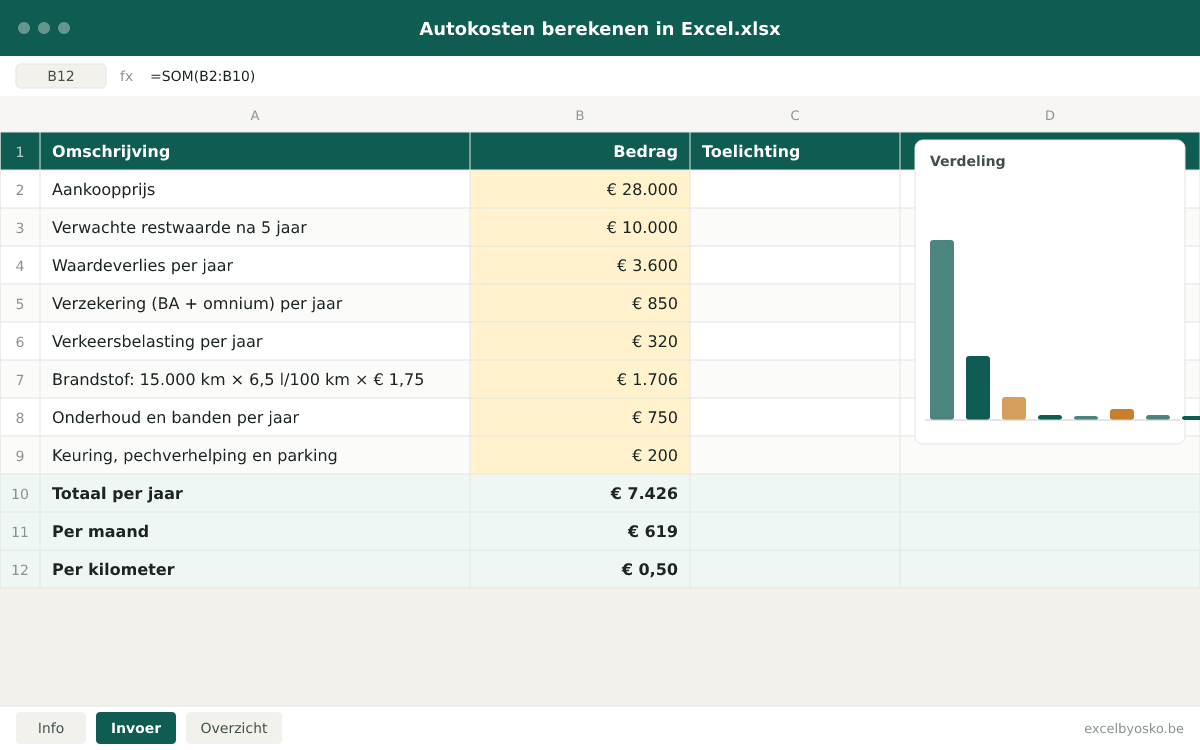
A family car of €28,000, kept for five years, 15,000 km per year. The figures are rounded and serve only as an illustration.
| Purchase price | €28,000 |
|---|---|
| Expected residual value after 5 years | €10,000 |
| Depreciation per year | €3,600 |
| Insurance (liability + comprehensive) per year | €850 |
| Road tax per year | €320 |
| Fuel: 15,000 km × 6.5 l/100 km × €1.75 | €1,706 |
| Maintenance and tyres per year | €750 |
| Inspection, breakdown assistance and parking | €200 |
| Total per year | €7,426 |
| Per month | €619 |
| Per kilometre | €0.50 |
In this example depreciation is the largest cost, bigger than fuel. That is the case for most cars younger than eight years.
Sources & calculation method
This is how the calculation is built:
- Depreciation is calculated linearly: (purchase price − expected residual value) ÷ number of years of use. That is a deliberate simplification; in reality a car loses most of its value in the first years.
- Fixed costs (insurance, road tax, inspection, breakdown assistance, parking) are entered per year and divided by twelve for the monthly cost.
- Variable costs are calculated as annual mileage × consumption per 100 km × price per litre or kWh, plus a yearly amount for maintenance and tyres.
- The cost per kilometre is the yearly total divided by the annual mileage.
- Financing costs (interest on a car loan) are a separate, optional line in the extended version. Fill it in if you borrow; leave it empty if you pay cash.
Assumptions
- Road tax and registration tax differ per region and per car. The file uses the amount you enter, not a rate table.
- Fuel and electricity prices are free to enter. The example values are indicative and date from the last update.
- Tax deductibility of car costs for self-employed people is not taken into account; that needs a separate calculation with your accountant.
- The residual value is an estimate. A difference of a few thousand euros changes the yearly cost noticeably.
Limitations
- The file is neither a quote nor tax advice.
- It does not calculate road tax automatically from fiscal horsepower, CO2 emissions or weight.
- Leasing and renting have a different cost structure. The extended version contains a simple comparison, not a full lease calculation.
Sources
- Vlaamse Belastingdienst – Verkeersbelasting
Used for: What the annual road tax covers and what it depends on (Flemish Region).
Accessed: September 24, 2026
- FOD Economie – Energieprijzen en maximumprijzen voor brandstoffen
Used for: Indicative fuel prices in the example; the official maximum prices are published here.
Accessed: September 24, 2026
- Brussel Fiscaliteit – Verkeersbelasting
Used for: Road tax for cars registered in the Brussels-Capital Region.
Accessed: September 24, 2026
- SPW Finances – Fiscalité wallonne
Used for: Road tax and registration tax in the Walloon Region.
Accessed: September 24, 2026
This page and the file were last updated on September 24, 2026. Legislation and rates may have changed since.
Frequently asked questions
How much does a car cost per month in Belgium on average?
That depends heavily on the car, its age and the mileage. For a new family car kept for five years and driven 15,000 km per year, the total cost quickly reaches €500 to €700 per month, of which depreciation is the largest part. A second-hand car a few years old costs noticeably less, mainly because of lower depreciation.
How do I calculate the cost per kilometre of my car?
Add up all yearly costs: depreciation, insurance, road tax, fuel or charging, maintenance, tyres and smaller items such as inspection and parking. Divide that total by the number of kilometres you drive per year. In the example above that is €7,426 ÷ 15,000 km = €0.50 per kilometre.
Is an electric car cheaper to run?
Usually the variable costs are lower: charging generally costs less per kilometre than refuelling, and there is less maintenance. Against that stand a higher purchase price and uncertainty about the residual value. With the extended version you can put both cars side by side with your own figures, so you see the effect of consumption and residual value.
Where do I find my road tax?
Road tax is charged yearly by the tax administration of your region. The amount is on the assessment notice you receive by post or online. In Flanders you can also look it up through the Flemish Tax Administration; Brussels and Wallonia have their own service.
Can I use this file as a self-employed person?
Yes, to know the real cost of your car. For the tax side, such as the deductibility of car costs and the benefit in kind, separate rules apply that depend on the type of car and the year of purchase. Discuss those with your accountant; this file deliberately does not calculate them.
Osko Consult
Want more insight into your financial situation?
Osko Consult builds overviews, calculators and dashboards to order, also for small organisations and self-employed people. An Excel that does exactly what you need, instead of a template that almost fits.
Related tools
- Excel templateOnline calculator
Loan repayment calculator in Excel
Work out your monthly payment, see in a full repayment schedule how much interest and capital you pay each month, and find out what a loan costs you over its whole term.
Individuals · Self-employedFree - Excel template
Household budget template in Excel
Line up your income, fixed costs and variable spending month by month and see straight away how much is left to save, with a comparison between budget and actual.
IndividualsFree - Excel template
Loan comparison template in Excel
Put up to four loan offers side by side with amount, term, nominal rate, APR, monthly payment and all costs, and see at once which loan is cheapest over the whole term.
Individuals · Self-employed · SMEsFree - Excel templateOnline calculator
Part-time work: what is left net? (Excel)
Compare your gross salary and an indicative net salary at 100, 90, 80, 60 and 50% and see the difference per month and per year, including the effect on holiday pay and the end-of-year bonus.
IndividualsFree