Salary vs dividend comparison in Excel
Compare what is left net when your company pays out the same profit as director’s salary or as a dividend, with corporate tax, social contributions, personal income tax and withholding tax.
You see at a glance how many euros net each route yields and what a higher salary costs you in social contributions and tax.
- Last updated:
- Published:
Available versions
FreeChoose the version that suits you. All versions are free.
Basic
Version 1.0 · last updated September 24, 2026The same profit paid out as director’s salary or as a dividend, with corporate tax, social contributions, simplified personal income tax and withholding tax. Net in the director’s hands in both scenarios, with an adjustable parameter sheet.
Works with Excel 2016+, Microsoft 365, LibreOffice Calc
Download Basic (English, 9 kB)Also available in: Nederlands, Français
Free · No account · No email
In short
The salary versus dividend choice is a director’s trade-off between a remuneration, deductible for the company but subject to social contributions and progressive personal income tax, and a dividend, paid out of profit after corporate tax and subject to withholding tax.
As director of a bv you decide how the profit reaches you: as salary, as a dividend or as a mix of both. Each route passes through different taxes and contributions. This Excel puts both routes side by side for the same amount of profit and shows what ends up net in your hands.
What does this tool do?
On the input sheet you enter the profit your company can pay out and the amount you want to take as salary. The file calculates scenario A, in which the full amount is paid as salary, and scenario B, in which you take a salary and pay out the rest as a dividend. For each scenario you see the social contributions, the personal income tax, the corporate tax and the withholding tax, with the net amount at the bottom.
Salary and dividend are fundamentally different. A salary is a cost for the company and therefore lowers the taxable profit, but you pay social contributions and progressive personal income tax on it. In return you build up social rights such as pension and health insurance, and a minimum salary is one of the conditions for the reduced corporate tax rate. A dividend is only paid out of the profit that remains after corporate tax, and the company withholds tax on it when it is paid. It builds no social rights.
All rates sit on a separate parameter sheet: the corporate tax rate, the social contribution percentage, the simplified personal income tax rate and the withholding tax rate. You adjust them when the law changes or when your situation differs, for example when your company qualifies for the 15 % VVPRbis rate.
Who is it for?
- Directors of a bv who are unsure whether to pay themselves more salary or a dividend.
- Starters who have just set up a company and want to understand why their accountant proposes a particular salary.
- Self-employed people considering the switch to a company who want to see how profit from a company is taxed.
- Anyone who wants to prepare a conversation with their accountant with concrete figures instead of gut feeling.
What is included?
- Input sheet with the available profit, the desired salary and the applicable withholding tax rate.
- Scenario A: the full amount as director’s salary, with social contributions and personal income tax.
- Scenario B: a salary of your choice plus the rest as a dividend, with corporate tax and withholding tax.
- Overview with the net amount per scenario, the difference in euros and the total tax burden as a percentage.
- Parameter sheet with all rates, amounts and thresholds, with the source and the date of the last check.
- A note next to every input cell and every simplification, so you know what the file does and does not include.
How do you use the file?
- 1
Open the file and go to the “Input” sheet. Only the yellow cells are meant to be filled in.
- 2
Enter the profit your company can pay out this year, before your own salary and before corporate tax. Your accountant can give you this figure based on the interim accounts.
- 3
Enter the salary you want to take in scenario B. Start with what you receive today, or with the minimum salary for the reduced rate, and vary from there.
- 4
Choose the withholding tax rate: the standard 30 %, or 15 % if your company meets the VVPRbis conditions. If in doubt, ask your accountant.
- 5
Check on the parameter sheet whether the rates for corporate tax, social contributions and personal income tax are still correct and adjust them where needed.
- 6
Look at the “Overview” sheet: both scenarios sit side by side, with the net amount, the difference and the total tax burden. Change the salary on the input sheet to see at which amount the balance tips.
Worked example
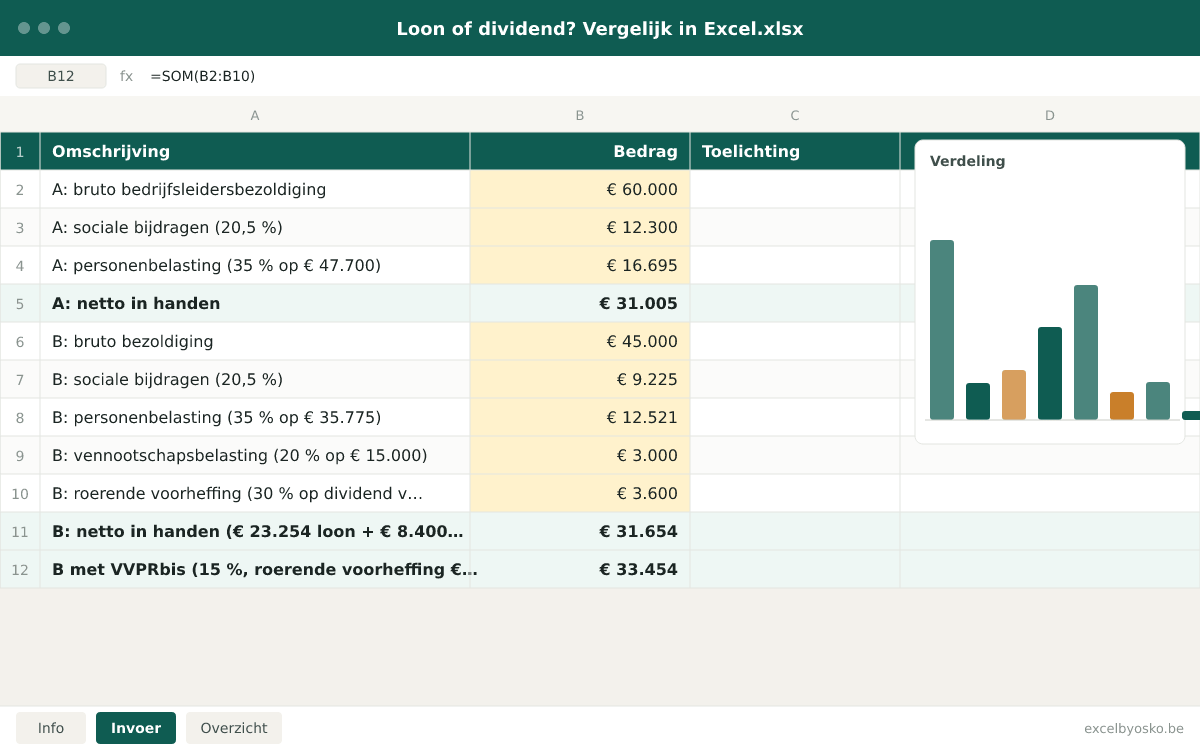
A bv has €60,000 of profit available, before the director’s salary and before corporate tax. Simplified assumptions: social contributions of 20.5 % on the salary, an effective personal income tax rate of 35 % on the salary after contributions, 20 % corporate tax and 30 % withholding tax. Figures are rounded to the euro.
| A: gross director’s salary | €60,000 |
|---|---|
| A: social contributions (20.5 %) | €12,300 |
| A: personal income tax (35 % on €47,700) | €16,695 |
| A: net in hand | €31,005 |
| B: gross salary | €45,000 |
| B: social contributions (20.5 %) | €9,225 |
| B: personal income tax (35 % on €35,775) | €12,521 |
| B: corporate tax (20 % on €15,000) | €3,000 |
| B: withholding tax (30 % on a €12,000 dividend) | €3,600 |
| B: net in hand (€23,254 salary + €8,400 dividend) | €31,654 |
| B with VVPRbis (15 %, withholding tax €1,800) | €33,454 |
At the standard 30 % rate the gap is a few hundred euros; with VVPRbis it grows to almost €2,500 per year in favour of the dividend. The example applies the same effective personal income tax rate to both scenarios. In reality the extra €15,000 of salary in scenario A falls into the highest brackets, which widens the gap further. Remember that the salary in scenario A does build up more pension rights.
Sources & calculation method
This is how the calculation is built:
- Scenario A: the full available amount is paid as salary. Social contributions = salary × contribution percentage. Personal income tax = (salary − social contributions) × simplified rate. Net = salary − social contributions − tax.
- Scenario B: the chosen salary follows the same calculation as in scenario A. The rest of the available amount stays in the company as profit.
- Corporate tax = (available amount − salary) × corporate tax rate. The file uses 20 % by default (reduced rate for small companies on the first €100,000) and shows a warning when the salary is below the minimum remuneration on the parameter sheet.
- Dividend = profit after corporate tax. Withholding tax = dividend × chosen rate (30 % or 15 %). Net dividend = dividend − withholding tax.
- Net in hand in scenario B = net salary + net dividend. The overview shows the difference with scenario A in euros and the total tax burden: all contributions and taxes together, divided by the available amount.
Assumptions
- Personal income tax is calculated in a simplified way with a single effective rate you set yourself (35 % in the example). The real rate is progressive, from 25 % to 50 % per income bracket, with a tax-free allowance and a municipal surcharge. For a precise calculation use our personal income tax tool or ask your accountant for a simulation.
- Social contributions are calculated as a flat percentage of the salary (20.5 % in the example, the rate for a self-employed person in main occupation up to the first ceiling). The real calculation is based on net taxable professional income, has a minimum contribution, a lower rate above the first ceiling and management fees charged by the social insurance fund.
- The reduced corporate tax rate of 20 % only applies to small companies that meet all conditions, including a salary of at least €45,000 to at least one director, or a salary at least equal to the company’s taxable income. Otherwise the rate is 25 %.
- The 15 % VVPRbis rate only applies to shares that meet the conditions of article 269, § 2 ITC 92, and only from the profit distribution of the third financial year after the contribution. Have your accountant confirm whether your shares qualify.
Limitations
- The file is an indicative comparison, not tax advice and not a substitute for a calculation by your accountant.
- It does not include pension build-up, VAPZ/PLCI or IPT/EIP, health insurance or other social rights that only a salary provides, nor benefits in kind, expense allowances or a liquidation reserve.
- It assumes the profit is paid out in full. Profit that stays in the company to invest or as a reserve is taxed differently and is not part of the comparison.
Sources
- FOD Financiën – Toelichting bij de aangifte in de vennootschapsbelasting (aanslagjaar 2025)
Used for: Standard rate of 25 %, reduced rate of 20 % on the first €100,000 for small companies and the condition of a salary of at least €45,000 to a director (art. 215 ITC 92).
Accessed: September 24, 2026
- FOD Financiën – Roerende voorheffing
Used for: Basic 30 % withholding tax rate on dividends and how the company withholds and pays it.
Accessed: September 24, 2026
- FOD Financiën – Aangifte 273A Div, aanslagvoeten roerende voorheffing op dividenden
Used for: Reduced rates of 20 % and 15 % for VVPRbis shares (art. 269, § 2 ITC 92) and the rates on distribution of a liquidation reserve.
Accessed: September 24, 2026
- RSVZ – Hoeveel sociale bijdragen moet ik betalen?
Used for: Rate of 20.5 % on professional income up to the first ceiling, 14.16 % above it, the minimum contribution and the management fees of the social insurance fund.
Accessed: September 24, 2026
- FOD Financiën – Belastingtarieven personenbelasting
Used for: Progressive brackets from 25 % to 50 % on which the simplified effective rate in the file is based.
Accessed: September 24, 2026
This page and the file were last updated on September 24, 2026. Legislation and rates may have changed since.
Frequently asked questions
Which is better: salary or dividend?
That depends on the amount, on the rates that apply to your company and on what you want to do with the money. A dividend bears 20 % or 25 % corporate tax in total and then 30 % or 15 % withholding tax, without social contributions. A salary bears social contributions and progressive personal income tax, but it is deductible and builds pension rights. A combination is often best: a salary high enough for the reduced rate and for your social protection, and the rest as a dividend. The file shows where the balance tips.
Why should I pay myself at least €45,000 in salary?
You do not have to, but it is one of the conditions for the reduced corporate tax rate of 20 % on the first €100,000 of profit. A small company does not qualify if it grants no director a salary of at least €45,000, unless that salary is at least equal to the company’s taxable income. With a modest profit a lower salary therefore suffices. If you pay yourself too little, the company pays 25 % on the whole profit. The parameter sheet contains the threshold, so you see the effect immediately.
How much withholding tax do I pay on a dividend?
The basic withholding tax rate on dividends is 30 %. The company withholds that amount and pays it to the tax authorities; you receive the net dividend. For shares in small companies that meet the VVPRbis conditions, the rate drops to 20 % for the profit distribution of the second financial year after the contribution and to 15 % from the third year onwards. A liquidation reserve also leads to a lower levy, but only after a waiting period. Choose on the input sheet the rate that applies to your shares.
Do I pay social contributions on a dividend?
No. Social contributions for the self-employed are calculated on your professional income, and a dividend is not part of it. That makes a dividend cheaper, but it also builds no rights: no pension, no sickness benefit, no bridging right. As a director in main occupation you pay 20.5 % on your salary up to a first ceiling and a lower percentage above it, with a minimum contribution even if you pay yourself little or no salary. A salary that only aims at that minimum therefore also gives only a minimal pension.
What is a liquidation reserve and is it in the file?
A liquidation reserve is profit after corporate tax that a small company sets aside and on which it immediately pays a separate levy. If it only pays out the reserve after a waiting period, a lower withholding tax than the usual 30 % applies, and the money stays available in the company in the meantime. It is a popular way to take money out of the company more cheaply, but you must be able to do without it for years. The file does not calculate the liquidation reserve; the rates and the waiting period change regularly, so discuss it with your accountant.
Osko Consult
Want this calculation tailored to your situation or your clients?
Osko Consult builds custom calculators and Excel models, with your parameters, your house style and the checks that matter to you.
Related tools
- Excel template
Sole trader or company? Compare in Excel
Compare, for the same profit, what you keep net as a sole trader and as a company, including the extra yearly costs of a company, and see from which profit level a bv starts to pay off.
Self-employedFree - Excel template
Belgian personal income tax calculator in Excel
Estimate the Belgian personal income tax on your salary or profit: tax brackets, personal tax allowance and municipal tax for assessment year 2026, with the assessment year 2027 figures already in the parameter sheet.
Individuals · Self-employedFree - Excel template
Cashflow forecast template in Excel
Plan your business’s incoming and outgoing cash month by month and see in advance when your balance hits its lowest point: customer receipts, suppliers, wages, VAT and loans on one sheet.
Self-employed · SMEsFree - Excel template
Financial plan template in Excel
Draw up a three-year financial plan: revenue, costs, result, cashflow and break-even revenue, with investments, financing and a balance sheet per year in the extended version.
Self-employed · SMEsFree