Sole trader or company? Compare in Excel
Compare, for the same profit, what you keep net as a sole trader and as a company, including the extra yearly costs of a company, and see from which profit level a bv starts to pay off.
You get a numerical answer to whether a company is already worth it for you, before you sit down with the notary.
- Last updated:
- Published:
Available versions
FreeChoose the version that suits you. All versions are free.
Basic
Version 1.0 · last updated September 24, 2026The same profit level as a sole trader (all profit in personal income tax plus social contributions) and as a company (salary, corporate tax and dividend), with the extra yearly costs of a company as inputs, a break-even indication and a parameter sheet.
Works with Excel 2016+, Microsoft 365, LibreOffice Calc
Download Basic (English, 9 kB)Also available in: Nederlands, Français
Free · No account · No email
In short
The sole trader versus company choice is the trade-off between a simple structure in which all profit falls into progressive personal income tax, and a separate legal entity subject to corporate tax, with more administration and extra costs, but with limited liability and more ways to steer the profit.
Almost every self-employed person faces the question at some point: should I set up a company? The answer depends on your profit, on what you want to do with it and on how much administration and cost you are willing to take on. This Excel puts both structures side by side for the same profit level and shows the difference in euros.
What does this tool do?
On the input sheet you enter the expected yearly profit, the salary you would pay yourself in a company and the extra yearly costs of a company: accountant, filing of the annual accounts and set-up costs spread over a few years. For the sole trader the file calculates social contributions and personal income tax on the full profit; for the company it calculates social contributions and personal income tax on the salary, corporate tax on the remaining profit and withholding tax on the dividend.
As a sole trader the profit is your income: everything falls into progressive personal income tax and counts for your social contributions. A company is a separate legal entity that pays tax on its own profit. You choose how much you take as salary and how much stays in the company or is paid out as a dividend. The higher the profit, the wider the gap between the 50 % top rate of personal income tax and the 20 % or 25 % corporate tax rate.
The financial difference is only one side of the story. A company separates your private assets from your business risk, but requires a notarial deed of incorporation, a financial plan, double-entry bookkeeping and annual accounts filed with the National Bank. That is why the file gives, next to the net difference, a break-even indication: the profit level at which the advantage of the company exceeds its extra costs.
Who is it for?
- Self-employed people in main occupation whose profit is growing and who want to know whether a company already pays off.
- Starters who are unsure whether to set up a bv right away or to start as a sole trader first.
- Liberal professions and consultants who want to set aside part of their profit for investments or for later.
- Anyone who wants to walk into the accountant’s or notary’s office with their own calculation and the right questions.
What is included?
- Input sheet with the yearly profit, the desired salary and the extra yearly costs of a company.
- Sole trader calculation: social contributions and personal income tax on the full profit, with the net amount.
- Company calculation: salary, corporate tax on the remaining profit and withholding tax on the dividend.
- Overview with the net difference in euros, the total tax burden per structure and a break-even indication.
- Parameter sheet with the tax brackets, the social contribution percentage and the corporate and withholding tax rates.
- Checklist of the non-financial differences: liability, incorporation, bookkeeping and annual accounts.
How do you use the file?
- 1
Open the file and go to the “Input” sheet. Only the yellow cells are meant to be filled in.
- 2
Enter your expected yearly profit: turnover minus business expenses, before social contributions and taxes. Take last year’s figure as a basis and adjust it to your expectations.
- 3
Enter the salary you would pay yourself in the company. An amount of €45,000 is a common starting point, because it is one of the conditions for the reduced corporate tax rate.
- 4
Enter the extra yearly costs of a company: the difference in accountant’s fees, the filing of the annual accounts and the set-up costs spread over the number of years you choose.
- 5
Choose whether the remaining profit is paid out as a dividend or stays in the company, and choose the withholding tax rate (30 % or 15 % under VVPRbis).
- 6
Look at the “Overview” sheet: both structures sit side by side with the net amount, the difference and the break-even indication. Vary the profit on the input sheet to see from which level the company starts to pay off.
Worked example
A self-employed person expects €70,000 of profit, after business expenses and before social contributions and taxes. Simplified assumptions: social contributions of 20.5 % on the profit or the salary, personal income tax according to the brackets of assessment year 2026 (25 % up to €16,320, 40 % up to €28,800, 45 % up to €49,840, 50 % above) without tax-free allowance and without municipal surcharge, 20 % corporate tax, 30 % withholding tax and €3,500 of extra yearly costs for the company. Figures are rounded to the euro.
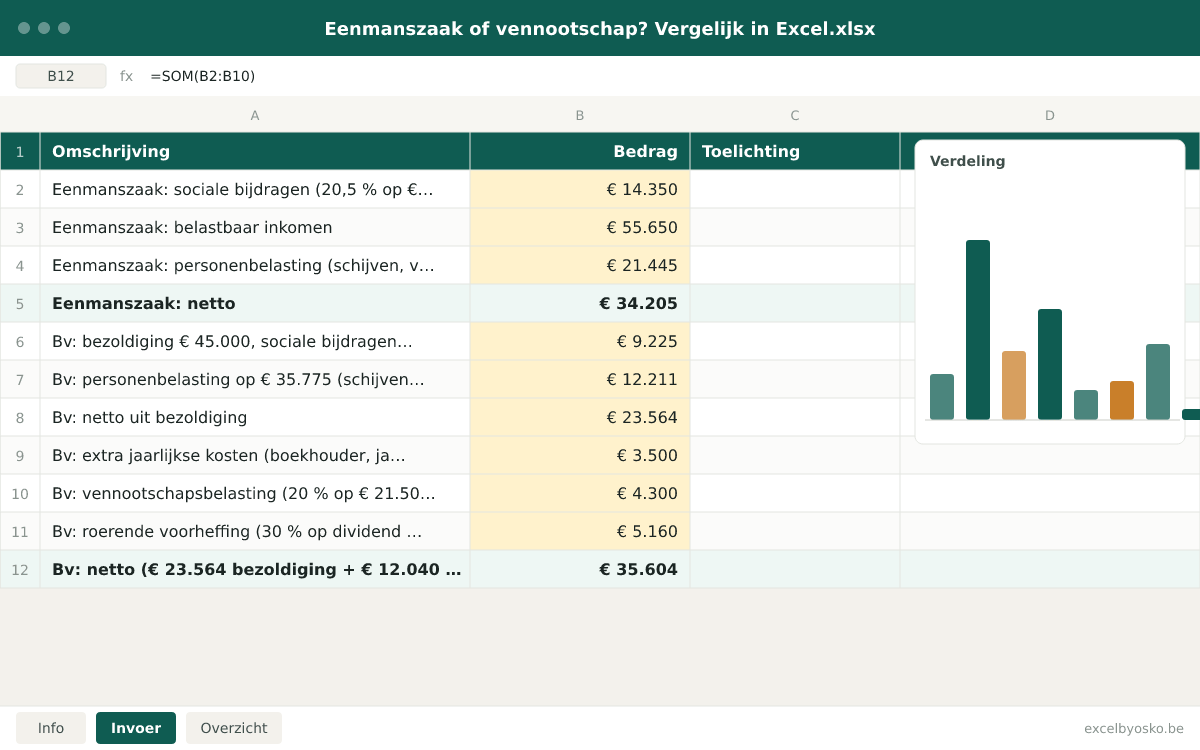
| Sole trader: social contributions (20.5 % on €70,000) | €14,350 |
|---|---|
| Sole trader: taxable income | €55,650 |
| Sole trader: personal income tax (brackets, simplified) | €21,445 |
| Sole trader: net | €34,205 |
| Company: salary of €45,000, social contributions (20.5 %) | €9,225 |
| Company: personal income tax on €35,775 (brackets, simplified) | €12,211 |
| Company: net from salary | €23,564 |
| Company: extra yearly costs (accountant, annual accounts, set-up) | €3,500 |
| Company: corporate tax (20 % on €21,500) | €4,300 |
| Company: withholding tax (30 % on a €17,200 dividend) | €5,160 |
| Company: net (€23,564 salary + €12,040 dividend) | €35,604 |
At €70,000 of profit the company keeps €1,399 more than the sole trader in this example, despite €3,500 of extra costs. With the 15 % VVPRbis rate that becomes €3,979. If you leave the profit in the company to invest, the gap is even larger, because the withholding tax disappears. At a lower profit the balance tips: as long as the profit after salary stays small, the fixed extra costs weigh more than the rate advantage.
Sources & calculation method
This is how the calculation is built:
- Sole trader: social contributions = profit × contribution percentage. Taxable income = profit − social contributions. Personal income tax = sum of the brackets on the parameter sheet. Net = taxable income − tax.
- Company, director: the salary follows the same calculation as the sole trader, but on the salary instead of on the full profit.
- Company, legal entity: taxable profit = profit − salary − extra costs. Corporate tax = taxable profit × rate (20 % on the first €100,000 for small companies that meet the conditions, otherwise 25 %).
- Dividend = profit after corporate tax, if you choose to pay it out. Withholding tax = dividend × rate. If you choose to retain it, that amount stays in the company and the overview counts it as wealth inside the company, separate from the net amount in private hands.
- Break-even indication: the file repeats the calculation for a range of profit levels and shows from which level the company’s net exceeds the sole trader’s, for the salary and costs you entered.
Assumptions
- Personal income tax is calculated with the tax brackets of the assessment year on the parameter sheet, without tax-free allowance, without municipal surcharge and without deductions. That overstates the tax at low incomes and slightly understates it by leaving out the municipal surcharge.
- Social contributions are calculated at 20.5 % on the profit or salary up to the first ceiling and 14.16 % on the part above it, without management fees. In reality the calculation is based on the net taxable professional income fixed by the tax authorities, and a minimum contribution applies.
- The reduced corporate tax rate of 20 % assumes a small company that meets all conditions, including a salary of at least €45,000 to a director or a salary at least equal to the company’s taxable income.
- The extra costs of a company are an estimate you enter yourself. Expect higher accountant’s fees because of double-entry bookkeeping and annual accounts, the filing fee at the National Bank and the notary’s fees at incorporation, spread over a few years.
Limitations
- The file is an indicative comparison, not tax or legal advice. Choosing a company has consequences beyond taxes; discuss them with your accountant and notary.
- It does not include pension build-up, VAPZ/PLCI or IPT/EIP, benefits in kind, rent from a property you let to your company, copyright income or a liquidation reserve. Those can tip the balance in favour of the company.
- The file works with a single year. You spread the set-up costs yourself, and the costs and tax consequences of a later liquidation or of contributing your sole trader business to the company are not included.
Sources
- FOD Economie – Het juridische statuut voor een onderneming kiezen
Used for: Difference between sole trader and company: liability, personal income tax versus corporate tax and the considerations behind the choice.
Accessed: September 24, 2026
- Notaris.be – Een vennootschap oprichten
Used for: Notarial deed of incorporation, financial plan for the first two years, bank certificate and founders’ liability when the starting capital is inadequate.
Accessed: September 24, 2026
- FOD Financiën – Toelichting bij de aangifte in de vennootschapsbelasting (aanslagjaar 2025)
Used for: Standard rate of 25 %, reduced rate of 20 % on the first €100,000 and the €45,000 salary condition (art. 215 ITC 92).
Accessed: September 24, 2026
- RSVZ – Hoeveel sociale bijdragen moet ik betalen?
Used for: Rates of 20.5 % and 14.16 %, the ceilings and the minimum contribution used in the example and on the parameter sheet.
Accessed: September 24, 2026
- FOD Financiën – Belastingtarieven personenbelasting
Used for: Tax brackets from 25 % to 50 % for assessment year 2026 (income 2025) used in the example and on the parameter sheet.
Accessed: September 24, 2026
This page and the file were last updated on September 24, 2026. Legislation and rates may have changed since.
Frequently asked questions
From which profit is a company worthwhile?
There is no fixed threshold. A frequently quoted rule of thumb is that a company starts to pay off from roughly €60,000 to €70,000 of profit per year, but that depends on how much you need privately and how much you can leave in the company. Someone who needs the whole profit to live on gains little from a company, because that profit is paid out as salary anyway and therefore falls into personal income tax. Someone who can set part aside or pay it out as a dividend does benefit from the rate difference. The file gives a break-even indication based on your figures.
What does a company cost extra per year?
Expect higher accountant’s fees, because a company keeps double-entry books and draws up annual accounts that it files with the National Bank, which charges a filing fee. On top of that come, at incorporation, the notary’s fees for the deed, the publication in the Belgian Official Gazette and the drafting of the financial plan. Ask for quotes and enter the amounts on the input sheet; in the example we use €3,500 per year, a realistic order of magnitude for a small bv.
Am I liable with all my assets as a sole trader?
Yes. As a sole trader there is no separation between your business assets and your private assets. Creditors of your business can in principle claim against everything you own, including your home and your savings. In a bv your liability is in principle limited to what you contributed: creditors of the company cannot touch your private assets. That protection is not absolute: in case of a management error, a personal guarantee for a loan or a financial plan that was clearly inadequate at incorporation, you can still be held personally liable.
Do I need a notary and a financial plan to set up a bv?
Yes. A bv is incorporated by notarial deed, which the notary also files with the registry of the enterprise court. Before incorporation you hand the notary a financial plan that justifies the starting capital for a period of at least two years. The notary keeps that plan; it is not published. If the company goes bankrupt shortly after incorporation and the starting capital turns out to have been clearly inadequate, the founders can be held liable. So take the plan seriously: our Financial plan tool helps you draw it up.
Can I switch from sole trader to company later?
Yes, that is the usual path: many self-employed people start as a sole trader and set up a company once the profit and the activity justify it. You can contribute the business of your sole trader activity to the new company or sell it to the company. Both have tax consequences, for example for cessation gains and VAT, and require a valuation. Your social status simply continues: you remain self-employed, now as a director. Preferably plan the switch at the start of a financial year and discuss the timing and valuation with your accountant beforehand.
Osko Consult
Need something similar for your own business?
Osko Consult helps businesses with financial planning, dashboards, Excel solutions and custom automation. From a one-off model to fully automated reporting.
Related tools
- Excel template
Salary vs dividend comparison in Excel
Compare what is left net when your company pays out the same profit as director’s salary or as a dividend, with corporate tax, social contributions, personal income tax and withholding tax.
Self-employedFree - Excel template
Belgian personal income tax calculator in Excel
Estimate the Belgian personal income tax on your salary or profit: tax brackets, personal tax allowance and municipal tax for assessment year 2026, with the assessment year 2027 figures already in the parameter sheet.
Individuals · Self-employedFree - Excel template
Financial plan template in Excel
Draw up a three-year financial plan: revenue, costs, result, cashflow and break-even revenue, with investments, financing and a balance sheet per year in the extended version.
Self-employed · SMEsFree